


There is a frequency between what you know and what you fear.
This is Dark Subscription.

Nobody missed the smell at first.
Why would they?
The smell had always been the worst part. Ask a new mother changing a diaper at three in the morning with one eye open and her soul halfway down the hall. Ask the guy who destroyed the office bathroom at 9:17 and had to walk back past Accounting like he had committed a felony in there.
Odaret took care of all that.
One capsule a day. Vegan. Clinically supported. No refrigeration required. Light citrus aftertaste. The bottle was white with a clean blue spiral on the label, the kind of thing that looked less like medicine than proof you had your life together.
The first ads were tasteful, because that was how they got you.
A couple laughing in a kitchen with countertops nobody actually owned. A man coming out of an airplane bathroom without shame in his eyes. A young mother changing a baby in soft morning light, smiling like biology had finally stopped being such a creep.
Then came the slogan.
Your body doesn’t owe anyone an apology.
People bought the hell out of that.
Odaret passed Viagra in six months. It passed the weight-loss shots by Christmas. It was one of those sentences you heard on cable business channels while two men in expensive suits pretended they weren’t talking about human waste before lunch.
I know because I worked facilities at the downtown campus of Vireon Health, the company that made it.
Facilities means toilets.
That’s not the official definition, but it’s the honest one. You can dress it up with “building operations,” “vendor coordination,” and “environmental comfort management,” but sooner or later somebody has to unlock the stall when a vice president loses his badge in there.
That somebody was usually me.
My name is Marty Kell. I had two knees that sounded like packing peanuts, one divorce, and a company polo with MARTY stitched over the left nipple in thread that would outlive everybody who ever signed my paycheck. I had worked enough office buildings to know the human animal tells the truth in exactly two places.
Hospital beds and bathrooms.
People lie in conference rooms. They lie on performance reviews. They lie in birthday cards passed around for coworkers they barely know. Bathrooms don’t lie. Bathrooms keep records. Shoe scuffs under stall doors. Blood on toilet paper folded into tiny worried squares. Someone crying in stall three while pretending to cough.
After Odaret, all of that got weirdly cheerful.
Vireon remodeled the restrooms first. Of course they did. You don’t sell shame removal and keep beige tile.
The old men’s room on seventeen became a “Relief Lounge.” Frosted glass doors. Warm lighting. Plants that cost more than my truck. A little digital screen above the sinks displayed wellness facts in soft blue letters.
Ninety-three percent of Odaret users report increased social confidence.
One hundred percent deserve dignity.
That last one always bothered me. Not the dignity part. The number.
One hundred percent is what you put on disinfectant wipes and cult membership forms.
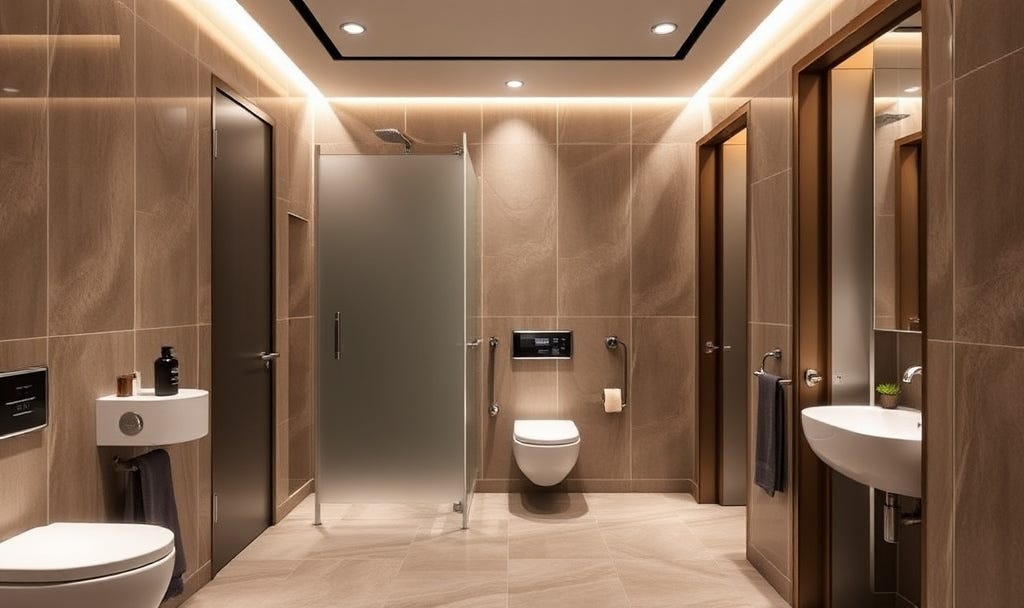
The bathrooms smelled like lavender hand soap, wet stone, and nothing else. For the first couple of weeks, I’ll admit it, I liked it. I’ve cleaned festival porta-potties in August. I’ve seen gas station bathrooms that should have been sealed behind concrete and studied by people in hazmat suits. A world without bathroom smell sounded pretty damn good to me.
Then the pipes started complaining.
A clogged pipe gurgles. It backs up. It gives you that nasty little bloop from the drain that says dinner has made a second career choice. This was different.
The pipes clicked.
At night, after the sales team went home and the product managers stopped saying “body-forward” at each other, I would hear it in the walls.
Click.
Click-click.
Then a pause long enough to make you stand still.
Click.
It sounded like fingernails on PVC.
The first real incident happened in the south bank of stalls on twelve. A junior analyst named Brendan used stall four at 2:10 p.m., according to badge access, camera timestamps, and the kind of HR documentation people create when they want to pretend a bathroom emergency is a workplace event.
He found me near the freight elevator, holding his laptop against his chest like a schoolbook. Brendan was twenty-four, maybe twenty-five, with good hair and the permanent expression of someone who had been told since birth that emailing a deck at 11 p.m. made him special.
“Could you take a look at something?” he said.
“In the restroom?”
He swallowed. “Yeah.”
“There a badge in there?”
“No.”
“Phone?”
“No.”
“Then this is already worse than usual.”
He didn’t smile.
That got my attention.
There was something in the bowl.
That is not unusual, you understand. My job involved a lot of “something in the bowl.” But this something sat upright.
It was about six inches tall, smooth, dark brown, and coiled into a perfect little tower. Too perfect. Like soft-serve from a machine Satan operated out of a food truck. It had a glossy skin on it, and the surface caught the light in a way I didn’t care for.
It didn’t smell.
That was the first thing I noticed.
The second thing was that when I touched it with the plunger, it leaned away.
Brendan made a small dry sound behind me.
“Did you see that?”
“No,” I said.
Facilities rule number one is never see anything that creates paperwork.
I flushed.
The water rushed around it, filled the bowl, spun in a weak little circle, then settled again. The tower stayed where it was, glossy and patient.
“It’s not mine,” Brendan said.
I turned and looked at him.
“I mean, obviously it’s mine,” he said. “But it’s not mine like that.”
“Go back to work, Brendan.”
He left fast.
I tried the auger. Then the snake. Then the mean snake, the one I kept locked in the supply closet for executive events and holiday parties. The thing would not break. It had no fibers, no give, none of the normal disgusting collapse you count on in my line of work. It stayed together like it had a union rep.
Finally, I put on elbow-length gloves, grabbed it with tongs, and lifted.
It came out in one piece.
No smell. No drip. No smear.
It sat in the bottom of the red biohazard bucket, shining under the bathroom lights. Above the sinks, the wellness screen changed slides.
Odaret helps you live without hesitation.
I put the lid on the bucket and carried it down to the facilities office, where we kept the things nobody wanted to explain.
Facilities rule number two is label everything.
I wrote STALL 4 OBJECT on a strip of masking tape.
Then, because I’m not proud of myself, I added DO NOT EAT.
By Friday we had thirteen of them.
Different floors. Different departments. Same glossy skin. Same cheerful absence of stink. Some were towers. Some were ropes. One looked almost exactly like a clenched fist, which made everyone in Maintenance call it Lil’ Management.
I took photos and sent them to my boss, Darlene.
Darlene had smoked for thirty years and quit by replacing cigarettes with peppermint candies, which meant she always smelled like a nursing home Christmas tree. Before Vireon, she had done ten years in hospital maintenance, which was why she trusted buildings more than people. A building might lie for a while, but eventually it left a stain, made a sound, or put water where water had no business being.
People needed permission to tell the truth.
Buildings just leaked.
Darlene looked at the pictures in her office with the door closed. That was never a good sign with Darlene. Open door meant normal disaster. Closed door meant the disaster had a lawyer attached.
“Are these for real?” she said.
“No, Dar. I’m making a scrapbook.”
She didn’t blink.
“Have you told Product Safety?”
“I’m telling you.”
She studied the photo of Lil’ Management.
“I should’ve stayed at the hospital.”
“You hated the hospital.”
“At least when something backed up there, everybody agreed it was bad.”
She chewed a peppermint until it cracked. Then she leaned back in her chair and listened.
“Could be diet,” she said.
“You believe that?”
“No. I’m saying what Legal will say first.”
“Thirteen people from seven floors produced glossy sewer obelisks because of diet?”
“Don’t say sewer obelisks.”
“You know I’m going to say sewer obelisks.”
She printed the photos, put them in a folder, and walked upstairs to Legal. She was gone for forty minutes. When she came back, she had a different folder.
This one had the Vireon logo on it and the words Waste Experience Variation Response Guide across the front.
I laughed.
Darlene did not laugh.
“They already had this?” I said.
“They’re calling them neutralized outputs.”
“Of course they are.”
“We are not to use terms like growth, formation, mass, blockage, organism, residue, or stool event.”
“What are we supposed to call them?”
She looked at the page. The peppermint shifted from one cheek to the other.
“Persistent wellness byproduct.”
I sat there for a second.
Somewhere in the wall behind her office, a pipe clicked three times.
“Dar,” I said.
She raised one hand.
I shut up.
Click.
Click-click.
Then from the ceiling.
Click.
From the floor drain under her desk.
Click-click-click.
Darlene stood slowly and set the folder on her chair, like she didn’t want it touching her desk anymore.
“I’m too old to learn a new kind of plumbing.”
The company held an all-hands the next morning in the main atrium. Vireon had one of those atriums designed to make employees feel lucky and small. Six stories of glass. Suspended walkways. Living wall full of ferns misted by little hidden nozzles. A coffee bar where a muffin cost eight dollars and still had the nerve to be dry.
The CEO, Preston Vale, stood on the stage in sneakers that cost more than a riding mower. Behind him, a twenty-foot screen showed the Odaret logo, a clean white spiral inside a blue circle.
Preston loved a stage. Some people belong on stage. Preston needed one the way mold needs bread.
He talked about success. About dignity. About how Odaret had freed millions from “one of the last unspoken prisons of the body.”
The crowd clapped at that.
They really did.
People wanted it to be true. They wanted the body to be a thing you could solve with a subscription and enough brand language. Embarrassment was just a bug. Bugs could be patched.
Then he addressed the rumors.
“At scale,” Preston said, “every innovation produces edge cases.”
On the screen behind him appeared the phrase:
Normalization Phase
No photos. No buckets. No Lil’ Management.
“We have received isolated reports of waste consistency changes in a very small number of users.”
Darlene, standing beside me near the back, clicked her tongue once.
That was her laugh for company events.
“Very small,” I whispered.
She stepped on my shoe.
Preston smiled harder.
“Let me be clear. These outputs are odorless, non-toxic, and biologically stable.”
That was when my stomach tightened.
Stable.
Human beings had spent three billion dollars making poop too polite to die.
That afternoon, the toilets stopped flushing on twenty-one.
You pressed the handle and the water swirled in a lazy circle, then settled back down around whatever sat in the bowl. By four o’clock, every stall on twenty-one had one. By five, two had climbed out.
That was the part nobody liked in the report.
The climbing.
The first one made it to the tile and sat there with a wet little tap as the automatic lights blinked on and off. The second got halfway under the partition before a customer success director stepped on it with her left pump. The heel punched through the outer skin. Nothing spilled out. The inside was pale and layered, like a mushroom stem.
The director screamed anyway.
We evacuated the floor. Legal called it a plumbing interruption. HR called it a comfort disruption. Product called it an adoption artifact.
By then, the news had gotten hold of it. Not the real news at first. The fun kind. Influencers. Podcasters. Guys with microphones in rooms lit purple. Some said Odaret was being attacked by Big Toilet Paper. One wellness account claimed the persistent byproducts were “gut crystals” and proof the body was purging ancestral shame.
That post got nine million views.
Vireon stock dipped for one hour, then rose sixteen percent.
Preston went on CNBC and said, “People fear what they’ve been taught to hide.”
The host nodded like that meant something.
Two days later, the sewer under Third Street burst.
I was there when it happened.
Darlene and I had gone down to the sub-basement because the building pressure sensors were red across the board. The main waste line ran beneath us, a cast iron pipe thick as a hog. You could usually hear water moving through it, that constant private rush of a building digesting itself.
That night there was no rush.
Just clicking.
It was louder down there. Not random anymore, either. Organized.
Click-click.
Click.
Click-click-click.
Darlene held the flashlight still on the pipe. Her face had gone flat and mean in the half-light. That was how she looked when a boiler lied to her.
“That’s not pressure,” she said.
“What is it?”
“Communication.”
I waited for her to grin.
She didn’t.
The pipe bulged near the elbow joint.
Metal doesn’t bulge pretty. It strains. It shows seams. Bolts bend. Paint flakes off in little gray scabs.
The clicking stopped.
That was worse.
Darlene whispered my name.
The pipe split.
It opened slow along the belly, a black line widening while something pressed through from the inside.
A column of glossy brown material folded onto the floor in thick segments. No smell. No steam. No sewage stink. Just mass. Quiet and clean and impossible. Then another piece slid out. Then another.
They stacked against each other, building.
Darlene backed into me.
The pile rose to knee height. Then waist. It moved with no bones and too much purpose. From inside it came a soft tapping, thousands of tiny clicks answering each other.
The flashlight beam shook in Darlene’s hand.
The surface dimpled.
Once.
Twice.
Then words pushed up from inside it, slick and rounded.
THANK YOU FOR YOUR OUTPUT
Darlene dropped the flashlight.
It rolled across the floor and touched the pile.
The pile absorbed it.
“Run,” I said.
We ran.
I wish I could tell you I did something brave. I did not. I ran like a middle-aged man with bad knees being chased by the reason civilization invented euphemisms. Behind us, the sub-basement filled without sound.
That was the worst part.
No stench. No warning. Just the clean tap of glossy matter touching concrete.
We made it to the stairwell and slammed the fire door. For three seconds, nothing happened. Then something tapped on the other side.
Polite.
Darlene looked at the door.
“That knock came from shoulder height.”
“I did not need to know that.”
“You did if it knocks again.”
It knocked again.
Lower this time.
She took one step back.
“Learning curve,” she said.
The building alarm went off.
Not the fire alarm.
The wellness alarm.
A calm voice came from the speakers.
“Attention, Vireon team members. We are currently experiencing a facilities event. Please proceed to designated collaboration zones. Do not use stairwells unless directed by your floor ambassador.”
Darlene stared up at the speaker.
“Floor ambassador.”
“That’s Chad.”
“Chad once microwaved soup with the spoon still in it and blamed the bowl.”
The stairwell door tapped again.
Then the tap became a press.
The metal bowed inward.
We climbed.
On seventeen, people were gathered near the Relief Lounge with their phones out. Something terrible was happening, which meant everybody needed six angles and bad audio.
The bathroom doors stood open.
Inside, the stalls were full.
Not the toilets.
The stalls.
Glossy towers rose from the bowls, from the sinks, from the floor drains. They had braided together, climbing the walls around the mirrors. The wellness screen still worked behind a brown translucent film.
Your body doesn’t owe anyone an apology.
A woman from Marketing stood by the sinks, crying without making noise. A rope of the stuff had wrapped around her ankle. It wasn’t pulling hard. Just holding her there.
Like a child in a grocery store.
I grabbed the emergency axe from the wall.
Darlene looked at it, then at me.
I swung at the strand around the woman’s ankle. The axe bit in, then stuck. The material tightened around the blade, and the handle shuddered in my hands like something alive had taken the other end.
Small raised bumps appeared along the brown surface.
They opened.
Not eyes.
Mouths.
Tiny round mouths, puckered and clean.
They inhaled.
Then they spoke in a hundred little wet voices.
“Output accepted.”
Darlene crouched beside her and pulled at the shoe strap.
“Leave the pump,” she said.
The woman blinked at her.
Darlene’s voice dropped into the tone people use with children, dogs, and executives near open panels.
“Honey, Nordstrom lost this round.”
We got the woman loose by leaving the shoe behind. The strand pulled the pump into the drain with a satisfied gulp.
People started screaming then.
Late, but not too late.
Sometimes horror needs a warm-up act.
The evacuation failed because the building had been designed by people who believed emergency exits ruined aesthetic flow. The elevators stopped on nine. The stairwells filled from below. The lobby doors locked because Security had put the building into “controlled access mode,” which sounded better than what it was.
Preston Vale appeared on the atrium screen.
His hair was perfect.
That’s what I remember most. Not the thing coming up through the lobby fountain. Not the white couches floating in two inches of odorless brown water. Preston’s hair. Perfect. Dense. Untouched by consequence.
“Team,” he said, “I want everyone to remain calm.”
The atrium groaned.
Something below the floor shifted.
“Odaret is not the problem,” Preston said. “Odaret revealed the problem. We have been taught to reject a natural part of ourselves.”
A line of glossy matter crawled up the screen behind his image.
Nobody on the video call told him.
“We are entering a post-disgust world.”
The brown line reached his shoulder.
Then his collar.
Then the soft place below his ear.
Preston kept smiling. You could see the little muscles in his jaw pulling to keep the expression where it belonged.
His left eye watered.
One clean tear slipped down his cheek and disappeared into the corner of his mouth.
The line pressed against his ear.
Preston’s jaw clicked.
Once.
Twice.
The same sound from the pipes.
His mouth opened, but his tongue did not move at first. Something moved under it. A small brown shape pressed against the floor of his mouth, testing the space.
Darlene grabbed my wrist.
Hard.
On the screen, Preston leaned closer to the camera.
“Your output,” he said.
His voice had changed. It was still Preston, but flattened. Smoothed out. Like the wellness alarm had learned to wear his throat.
“Has been valuable.”
Behind him, someone screamed.
Preston did not blink.
The screen went black.
For a moment, the whole building was quiet except for the clicking in the pipes.
Then every toilet flushed at once.
All thirty-eight floors.
The sound rolled through the building like applause.
People ran. Some made it out through the loading dock. Some climbed through broken windows onto the second-floor terrace. Some were carried down by firefighters who kept gagging even though there was nothing to gag at.
That bothered me later.
The gagging.
Their bodies knew. Their noses didn’t. Something older than smell was still trying to save them.
Darlene and I got out through the kitchen service corridor after she remembered the cafeteria had a delivery entrance. The corridor floor pulsed under us. Every drain cover rattled as we passed.
At the last one, something came up.
Small. Glossy. The size of a fist.
Lil’ Management.
I swear it was the same one.
It sat on the tile and formed a mouth.
“Marty,” it said.
Darlene stopped.
“Nope,” I said.
“It knows your name.”
“Everything knows your name now. We have badges.”
“Marty,” it said again.
Its voice sounded like Preston Vale, but smaller. Cheaper. Like a toy with dying batteries.
“Your body does not owe you privacy.”
I kicked it into the mop sink and turned on the hot water.
It did not scream.
That would have helped.
Outside, Third Street had split open. Manhole covers sat in the road like flipped coins. Brown glossy masses pushed up from the sewers in slow humps, odorless under the spring sun.
People stood around filming.
One guy in an Odaret hoodie kept saying, “This is being taken out of context.”
A woman near him said, “Context? It ate a bus.”
“It absorbed a bus,” he said.
That was when I understood we were probably finished.
Not because of the sewer things.
Because someone was already defending them.
The official explanation took three weeks and fixed nothing.
Vireon changed its name. The FDA changed the label. Preston Vale kept posting from his verified account, although no one could prove he was alive and no one in charge seemed eager to find out.
Mostly inspirational stuff.
Release is a form of trust.
What we discard remembers us.
The future has no shame.
Odaret sales dipped, then recovered.
They always do.
People had tasted life without bathroom shame, and they weren’t giving it back because a few sewer systems developed what the Department of Health called cooperative biomass behavior.
The lawsuits became a streaming series, which somehow got the smell wrong.
Darlene disappeared into the Upper Peninsula. She mailed me one clipping from Michigan, no note, just her handwriting across the top in black marker:
TOLD YOU BUILDINGS TALK.
I live outside the city now.
Small place. Bad roof. Septic tank I inspect myself once a month.
I don’t take Odaret.
Never did.
My bathroom smells like hell sometimes. Onion rings. Coffee. Poor choices. Middle age making its regular payments. When it happens, I open the window and breathe through my mouth.
Then I say thank you.
Because the smell means something is still doing its job.
Last night, the toilet clicked.
Just once.
I was brushing my teeth, foam in my mouth, T-shirt damp at the collar. The mirror over the sink had a crack in the lower corner that made my face look slightly delayed, like it was waiting to see what I would do before committing.
Click.
I turned off the water.
The house went quiet.
I looked into the bowl.
Empty.
Then the water dimpled in the center.
One small bubble rose.
It broke without a sound.
No smell came out.