


There is a frequency between what you know and what you fear.
He thought she kept coming back. She didn’t. He just never left.
This is Dark Subscription.
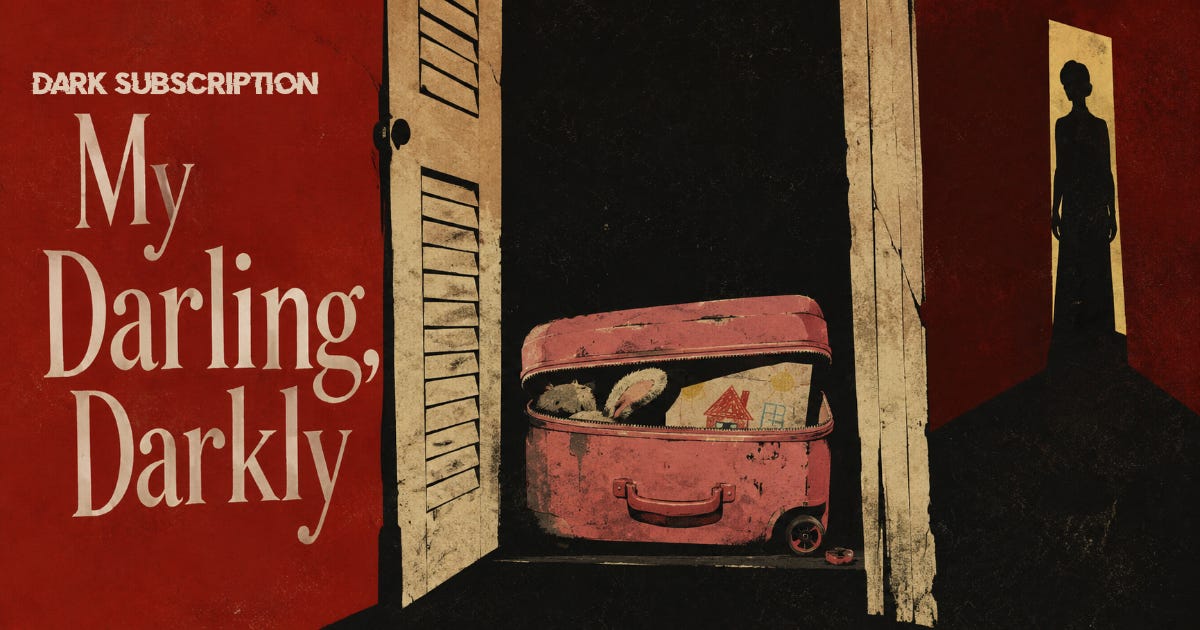
She only came at night.
No matter what else changed, no matter how much the house sagged and peeled and went soft with age.
Never mornings. Never afternoons. She belonged to the hours when the pipes ticked in the walls and the trees scraped at the siding.
Her name was Nina.
At least that was the name she gave me.
She came in carrying the smell of rain and cold air. Not fresh rain. Rain off asphalt and gutters and wet leaves mashed black against the curb. There was always something else under it too. A vague sweetness. Flowers left too long in dirty water.
The first night I saw her, she was standing in the bedroom doorway like she’d been there awhile.
“You still up?” she asked.
That was all.
I should tell you right now that I loved her. Fast and stupid and all at once. Some people hear that and laugh because they’ve spent their whole lives mistaking caution for wisdom. Let them. Every now and then somebody walks into your life and the whole room changes temperature. That’s not poetry. That’s physics.
She had dark hair. Pale skin. A mouth that always looked on the edge of either a smile or a warning. She never sat all the way back in a chair. Never got comfortable. Even in bed she seemed half-ready to leave.
That should have told me everything.
But lonely men are good at turning clues into decorations.
I lived alone in my father’s house. My mother had died when I was fourteen. My father lasted another nine years after that and then one Wednesday in August he sat down in his recliner with a ham sandwich and never woke up.
It wasn’t much. Two-story place on Bell Street. Narrow yard. Maple tree out front. Hall closet that never shut right. The kind of house that kept old smells. Cigarettes, damp plaster, radiator heat, dust cooked by summer sun.
She fit right in.
I used to wait up for her in the green chair by the bed, the one with the cigarette burn on the arm. Lamp off. Curtains open just enough for the streetlight to throw that weak orange glow across the carpet.
The house had its own language. The radiator downstairs gave a tired little shudder before it kicked on. The third stair complained. Water pipes knocked once, twice, like a fist in the wall. After a while I knew every sound well enough to tell which ones belonged there.
Then she appeared.
One second an empty doorway, then Nina leaning against the frame with rain in her hair.
Sometimes she crossed the room and touched my face with the backs of her fingers, cold enough to raise gooseflesh. Sometimes she stood at the window looking out at the yard longingly.
Mostly she talked in scraps.
“Same ugly curtains.”
Or, “You really never fixed that.”
Or once, so soft I almost thought I imagined it, “I hated this room.”
I’d ask where she went during the day, and she’d give me that one-corner smile.
“Not far.”
That answer sustained me for weeks.
I knew she wasn’t right. A person would have had to be blind not to know it.
But men like me, we learn what not to ask. We learn that love, if that’s what it is, comes with rules. You follow them or you lose the little bit you’ve got.
So I didn’t ask much.
I didn’t ask why she never ate.
I didn’t ask why my watch had stopped at 3:17.
I didn’t ask why the calendar in the kitchen still said October no matter how many times I stood there certain I’d just seen snow.
I didn’t ask why the radio only hissed.
I didn’t ask why my reflection had started looking thin.
Some nights she cried.
Never loud. Never dramatic. Just sat on the edge of the bed with her back to me, shoulders moving a little.
“What is it?” I asked once.
She shook her head.
“Nina.”
“If I’d just gone sooner,” she said.
I waited.
The house settled around us.
“If you’d gone sooner, what?”
She wiped her face and turned toward me, and there was something in her expression that made my stomach drop like a bad elevator.
Not grief. Not fear.
Recognition.
“You ask too much,” she said.
I said I was sorry.
That became our rhythm. Her silence. My apology. The dark between them.

Once, I took her hand and said, “Stay till morning.”
She went rigid.
“I can’t.”
“Why not?”
She looked at me then. Really looked.
“You know why.”
“No,” I said, and I heard how small my voice sounded in that room. “I don’t.”
The saddest thing I can tell you is this. I believed that.
For a while after that she stopped coming.
Or maybe she still came and I couldn’t bear to see her. Hard to say. Time had started slipping around by then. The house felt distant, like a voice holding back words.
Then I started hearing someone downstairs.
Not Nina.
Cabinet doors opening. The drag of cardboard on hardwood. A trash bag crackling.
A woman’s voice, young and tired and muttering to herself.
I stood at the top of the stairs listening.
Sunlight was coming through the front windows.
I went down anyway.
There was a young woman in the parlor, maybe twenty, twenty-one. Hair yanked up in a knot. Jeans, old sweatshirt, work gloves. She had open boxes around her and a roll of black trash bags by her feet. There was a gas can by the front door. The whole room smelled scrubbed raw.
She wasn’t sorting. She was moving through the rooms the way you move when you’ve already decided and just need your hands to catch up.
She was holding a framed picture.
Nina in a blue dress under the maple tree out front, sun in her hair, one hand up like she was telling whoever took the picture to knock it off.
I remembered taking it.
The girl stared at the picture a long time, thumb rubbing the glass.
Then she laughed a little, but there was no humor in it.
“You really kept everything,” she said.
Her voice hit me in the chest.
She had Nina in her. Not just in the face. In the posture. In the way she planted her feet like she expected resistance from the world and planned to outlast it.
On the mantel beside her was another photo I hadn’t noticed at first. Same girl, younger, maybe eight or nine, missing two front teeth, sitting on the front steps with a Popsicle stain on her shirt while Nina crouched beside her smiling into the sun.
My skin went cold.
The girl set down the frame and looked toward the hall closet.
“Don’t,” I said.
Nothing.
She couldn’t hear me.
She walked past the coffee table and knelt by the closet door. It was still the same cheap louvered thing. Same brass knob. Same gouge in the trim where it had slammed open too hard years ago.
“Mom always hated this closet,” she said to the room.
Then she added, “Said it smelled wrong.”
My mouth dried out.
Upstairs, a floorboard creaked.
I turned.
Nina stood at the top of the stairs.
Not pretty now. Not softened by darkness and want. Not the woman I’d let myself have in pieces.
Her throat was mottled black and purple. One side of her head was caved in where it had struck the hall table. There was dried blood in her hair. Dirt under her nails. Her dress, the yellow one from that last night, hung wrong at the shoulder where I’d grabbed it.
In one of her ears was the little silver hoop she used to wear when she dressed up.
That detail broke me worse than the blood.
Because it made it ordinary again.
A hallway. Her suitcase. My hand on her wrist. Her telling me to move. Then the shove.
Then the memory came back whole.
Her suitcase by the door.
Her saying, “Daniel, move.”
My hand clamped around her arm.
Her yanking free.
My temper flashing up hot and white because I heard something in her voice I couldn’t stand. The sound of somebody already gone.
I shoved her.
She hit the hall table.
Then the floor.
Then that wet, broken choking sound.
Then our daughter, nine years old, standing at the stairs in a nightshirt, staring down at us.
I actually staggered.
Down in the parlor, the girl, the woman now, reached for the closet knob with a gloved hand.
“Jaime,” I whispered.
Her name came out of me like something torn.
She froze.
Not because she heard me. Because Nina was moving.
She came down the stairs slow, one hand trailing the banister. Her eyes never left me.
Jaime shivered and rubbed her arms.
The closet door opened with that same little suck and pop.
Inside were paint cans, an old vacuum, a folded card table, a stack of boxes tied with twine.
Jaime stared.
Then she stepped in deeper and crouched.
“No,” I said, louder now. “No, don’t.”
She reached behind the card table and dragged something out by the handle.
A child’s pink suitcase.
Small. Scuffed. One wheel missing.
The one Nina had packed for Jaime before she told me they were leaving.
Jaime sat back on her heels staring at it. Her face had gone white in a way I’d seen once before in a bathroom mirror after too many drinks and not enough lies.
“What the hell,” she whispered.
She unzipped it.
Inside was a nightgown. A stuffed rabbit with one button eye. A toothbrush in a plastic case. And under those, folded neat as church clothes, a little stack of drawings in crayon.
One was of the house.
One was of Nina holding Jaime’s hand under a yellow sun.
One was three figures. Mommy. Me. Jaime.
Except my figure had been scribbled over in black so hard the paper tore.
Jaime made a small sound. Animal.
“I used to think maybe you left.”
Jaime looked toward the kitchen, then the back hall, like the house still knew the order of things better than she did.
“Then they took me away, and he was gone too.”
Nina had reached the bottom of the stairs.
Up close, she smelled like fresh dirt.
I stepped back.
“I loved you,” I said to her, and hated how helpless it sounded. How childish. Like love was a receipt I could still produce and have it count for something.
Nina stopped a few feet away.
“I know,” she said.
Same as before.
Then Jaime looked up.
Not at Nina.
At me.
Straight at me.
And for the first time, I understood what had been wrong from the start. The reason Nina never answered the daytime questions. Why clocks in the house had given up on me. The reason daylight felt fake.
Jaime saw me.
Her face tightened. Her eyes filled. Not with tears.
“Mom,” she whispered, still looking at me, “is he here?”
Nina never turned.
Never took her eyes off me.
“Yes,” she said.
Jaime stood up too fast, nearly tipping the suitcase. Her breath came short and sharp. She was crying now and didn’t seem to know it.
“All this time,” she said. “All this time you kept coming back here because…because of him?”
Nina’s voice was flat and tired and older than the house.
“No,” she said. “Because of you.”
That landed harder than anything.
Jaime nodded like somebody agreeing to surgery.
When she looked at me again, there was nothing of the little girl on the stairs. Nothing of the woman sorting boxes either.
Just Nina’s daughter.
Just a person who had finally found the thing that ruined her life.
“Good,” she said.
Then she walked to the front door and came back with the gas can. She unscrewed the cap and poured it into the pink suitcase until the rabbit darkened and sagged and the drawings bled color.
I stared at her.
Jaime reached into the cleaning caddy, took out a book of matches, and struck one.
“Nina,” I said.
But Nina was already stepping aside.
Jaime tossed the match in.
The suitcase went up with a flat hungry whump.
Flame licked the closet wall, caught old paper, then climbed.
Smoke rolled out fast and black.
Jaime backed away coughing, eyes watering, but she never looked away from me.
Neither did Nina.
Heat hit me then. Real heat. Terrible heat. For the first time in longer than I could measure, I felt the house take me back.
Jaime stumbled toward the front door, dragging one box, then letting it go.
At the threshold she stopped and turned.
Not to me.
To her mother.
“I’m sorry it took me so long,” she said.
Nina’s ruined face softened by half an inch.
Then Jaime was gone into the white hard daylight.
The fire climbed.
Wallpaper curled. Ceiling paint blistered. The hall filled with smoke so thick it turned the room into old film. Nina stood in it, steady, while I backed up toward the stairs and felt nothing beneath my feet at all.
“I loved you,” I said again, because there are men who will drag the same rotten sentence to hell and still expect it to open doors.
Nina came close enough for me to smell earth and rain and the sweet gone-over stink of flowers in dead water.
“I know,” she said. “My daughter was nine.”
Then she touched my face with her cold hand, almost tender.
And the house, which had been holding me all this time like a bad memory caught in its throat, finally let go.