

Special Presentation
This one isn’t part of the regular Dark Subscription episode order. Consider it a corrupted bonus track from the same machine.
Inspired by “The Devil Went Down to Georgia,” except the fiddle is a publish button, the golden instrument is an audience, and the devil has a better onboarding funnel than most startups.
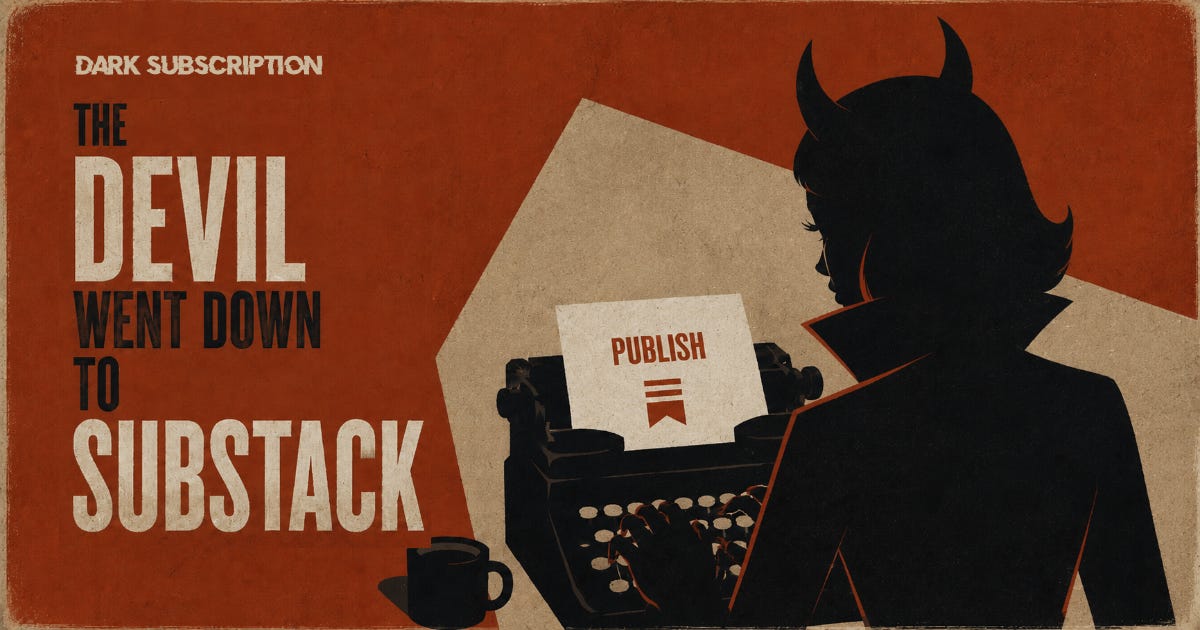
She called it audience development.
Her name was Lucy Scratch, which should have been enough right there. Founder of Morningstar Growth Labs, which should have been enough twice. Some people see a skull on a bottle and still take a sip because the label says artisanal.
I was one of those people.
Lucy had 1.3 million subscribers, and the number looked obscene in a way fake numbers usually don’t. It looked earned, which was worse.
I had 417 subscribers and a recurring dream where the number became 416 while I watched. In the dream, the lost subscriber was always my mother, even though she had already unsubscribed by accident and blamed the website. She still asked if I was “doing the blog,” in the same voice people use for sourdough starters and parole violations.
I wrote corporate horror, tech horror, bio horror when the news put on a lab coat and started licking the windows. Wellness apps counted your steps and slowly learned the shape of your grave. Biotech founders promised to reverse aging and mostly taught tumors to negotiate.
I took headlines and slid them six inches sideways.
Fiction, legally.
Horror, structurally.
One guy named Ron commented “Great stuff” on everything I posted, including a story where a biotech startup taught scar tissue to remember what hurt it.
Ron had range.
Lucy Scratch subscribed on a Thursday morning at 7:43. I remember the time because I was staring at the dashboard and pretending I wasn’t. This is a thing writers do. We pretend we’re above the numbers, then check them the way you check a sore tooth with your tongue.
The notification came in.
Lucy Scratch subscribed.
A minute later, she commented under my latest story.
I love what you’re building.
Ugh.
Nobody honest loves what you’re building. Building is sitting in your underwear at ten in the morning wondering if the story is bad or if everyone you know has finally gotten tired of pretending.
Of course I clicked her profile.
Her photo showed a woman in black-framed glasses and a cream blazer, leaning against a brick wall. Dark hair. Sharp cheekbones. Full mouth. Good skin. Not young-young, which made her more dangerous. She looked like a movie star after ten years of business class and private damage.

Her publication was called Morningstar Growth Labs, and her bio said she helped independent writers build sustainable audiences without losing their voice.
That was the first lie.
The second was sustainability.
She sent me a message at 8:02.
Coffee? I think I can help.
I wrote three versions of no, deleted all three, then typed:
Help with what?
Her reply came back before my finger left the trackpad.
Being seen.
Two words. Corny as hell. They still got in.
That’s the part people don’t like to admit about temptation. It doesn’t have to be smart. It just has to know where you itch.
I met her downtown at a coffee shop with exposed brick, hanging plants, and pastries lined up behind glass like they were waiting to testify. Lucy was already there, sitting at a corner table with a laptop open and a cup of coffee she had not touched. Cream blazer. White silk blouse. Gold chain at her throat. Black-framed glasses.
She looked exactly like her photo, which made me trust her less.
Profile pictures are supposed to lie a little.
“Thanks for coming,” she said.
Her voice was warm. Low. The kind of voice that made bad news sound like a premium feature.
“I almost didn’t.”
“I know.”
That sat there between us.
I pulled out the chair. “You know?”
Lucy smiled. “You typed three versions of no.”
My hand stayed on the back of the chair while she turned her laptop around.
My dashboard was on the screen. Not a screenshot. Live.
Subscriber count: 417.
Open rate. Click rate. Pledge conversions. Scroll depth.
I had never seen “scroll depth” before.
“You lose most readers after the third paragraph,” Lucy said. “Except when you write about systems that learn to want. Those hold longer.”
I sat down.
That was probably the real signature. Not the tablet later. Not the checkbox. Sitting down was the contract.
“I write about systems because systems are where the bodies are.”
“Sure,” she said. “But your bodies are always anonymized.”
“That’s fiction.”
“That’s hiding.”
The milk steamer screamed behind the counter. Nobody looked over.
Lucy folded her hands. “You don’t have a writing problem.”
“That sounds like something you charge $499 to say.”
“Seven ninety-nine,” she said. “But for you, I’ll waive it.”
I didn’t laugh.
She didn’t need me to.
“You have a visibility problem.”
“I have an audience problem.”
“No,” she said. “You have an honesty problem.”
Her phone buzzed. Lucy looked at the screen and sighed.
“One second. Client.”
She answered.
“No, Andy, I don’t think another video from the car helps.”
She listened.
“Because a personality disorder is not a content pillar.”
She hung up and slid the phone back into her bag.
“Sorry. Some men are very hard to scale.”
I looked at the dashboard. My subscriber count blinked.
417 became 416.
My stomach tightened before I could stop it.
Lucy saw.
That pissed me off more than losing the subscriber.
“You felt that.”
“No.”
“You did.”
“No one likes losing readers.”
“You didn’t lose a reader,” Lucy said. “You lost a witness.”
The coffee shop grew quiet around us.
Lucy reached into her bag and took out a business card.
Matte black. Raised white letters.
LUCY SCRATCH
Founder, Morningstar Growth Labs
Audience Strategy | Creator Systems | Sustainable Visibility
No phone number. No email. Just a QR code in the corner shaped a little too much like a mouth.
I looked at the card.
Then at her.
“Lucy Scratch,” I said.
“Yes.”
“Founder of Morningstar Growth Labs.”
“Also yes.”
“That’s subtle.”
She smiled.
“Subtle is bad for conversion.”
I should have left then. I knew that. You know that. Everybody who has ever heard a fiddle knows that.
But my dashboard still said 417 subscribers.
So I stayed.
Lucy slid the card closer. “One post. You and me. Same day. Same time. No bots. No boosts. No pity shares from other doomed little newsletter goblins.”
“You want to compete with me?”
“I want to give you a chance.”
“At what?”
“Winning.”
“You have 1.3 million subscribers.”
“Numbers aren’t readers.”
“That sounds like something people with 1.3 million subscribers say.”
Lucy leaned back. “There will be four metrics. Open rate. Engagement. Paid conversion. Retention.”
I understood the first three. The fourth made the hair on my arms rise.
“Retention?”
“How long the post stays with them.”
“That’s not a Substack metric.”
“No,” she said. “It’s older.”
Behind her, a man in a beanie laughed at something on his phone. The laugh died halfway out of his mouth. He coughed once and stared at the screen.
Lucy didn’t look away from me.
“If you win,” she said, “I make you famous.”
“And if you win?”
“I get your voice.”
“My writing voice?”
“Let’s not cheapen this by pretending there’s another kind.”
I should have stood up. Walked out. Called someone. A priest, maybe. Or my mother. Or Ron.
Instead I said, “For how long?”
Lucy’s smile changed by one degree.
“You’re a writer,” she said. “Don’t ask questions you already know the answer to.”
She opened a tablet with no logo and no case. The screen lit before she touched it, and a contract appeared. Just a creator services agreement with a scroll bar so small it looked like a hair trapped under glass.
I scanned the first paragraph.
It was written in the language of people who could drown a village with a comma.
At the bottom was a checkbox.
I didn’t read it.
Nobody reads those.
That was probably the oldest trick she had.
“What happens if I don’t sign?” I asked.
Lucy looked toward the window. Outside, people passed under a gray sky, heads bent toward their phones. Blue light on their faces. Thumbs moving. Mouths slack.
“Nothing,” she said. “You keep posting. Forty people keep opening. Ron keeps saying ‘great stuff’. Your mother keeps meaning to subscribe again.”
She looked back at me.
“You tell yourself those are different things.”
The checkbox waited.
The milk steamer screamed again.
This time it sounded like something with lungs.
I pressed my thumb to the screen. The tablet warmed under my skin, and every phone in the coffee shop went black for half a second.
Then everything came back.
Nobody reacted except the beanie guy, who shook his phone once and muttered, “Piece of crap.”
Lucy stood. “We publish tomorrow.”
“That’s fast.”
“Fame usually is.”
She picked up her untouched coffee and dropped it into the trash.
“Seven-thirty.”
Then she left.
No smoke. No goat hooves clicking on the tile. Just a cream blazer moving through the door and out into morning like she owned the weather.
I went home and tried to write.
That’s a lie.
I went home and stared.
The cursor blinked at the top of a blank draft. Title. Subtitle. Body. A little plus sign waited on the left side of the page, cheerful and stupid.
I started with a story about a startup that discovered grief could be measured through wearable devices and sold to employers as a retention risk score. It was good. It was also me hiding behind a badge reader, so I deleted it.
Then I tried a hospital story. An AI triage platform started denying organ transplants because the patients lacked “future-facing wellness indicators.” The software learned to smile in discharge summaries. A nurse found teeth growing in the server room wall.
Good image. Too easy.
Deleted.
Then biotech. A founder injected himself with something designed to make cells forget age. The cells forgot everything. Liver became lung. Bone became tooth. Skin became a wet committee with no chairperson.
Deleted.
The empty page looked better for a while. Then it looked like failure.
I could write about my father’s chair.
The green recliner he died in. Not died in, technically. He died in the ambulance. But the chair was where the dying started. One slipper off. Remote wedged under his thigh. Pretzel crumbs stuck in the seam. The TV still talking to nobody.
I could write about my divorce. Not the clean version, not the mutual-growth version. The real one, where I stood in the kitchen and said something I knew would hurt her because I wanted the room to hurt as much as I did.
I could write about my brother.
No.
Not that.
The cursor blinked.
I typed a title.
I Found My Father Where the Television Left Him
I hated it.
I also knew it would work.
My hands hovered over the keyboard.
Lucy’s phrase came back.
Pain converts.
I wrote fast for twenty minutes, and it was good. That was the worst part. The chair. The remote. The stale pretzels. My father’s mouth open, not dramatically, just loose. A little shine at the corner. The laugh track from a rerun landing in the room every eleven seconds.
I knew exactly where to stop.
I knew the final line before I got there.
I saw the comments before I posted.
This destroyed me.
I lost my father too.
Thank you for saying what I couldn’t.
So brave.
Great stuff.
I selected all.
Deleted it.
At 2:13 in the morning, my phone buzzed.
A message from Lucy.
Don’t overthink it. The wound already knows the shape of the knife.
I threw the phone onto the couch.
It landed screen-up.
Another message appeared.
Also, your title was too clever.
I didn’t sleep.
At 7:29 Friday morning, I sat at my desk with two drafts open. One was the father post. I had rewritten it after deleting it, then deleted it again, then reconstructed it from memory because apparently my self-respect had office hours.
The other draft was shorter.
Title:
My Dad’s Chair
No subtitle. No hook. No promise. Just the chair.
I had written it badly three times before I let it be plain.
The green recliner sat beside the window for nine months after he died. My mother said she was going to donate it. Then she was going to call the junk men. Then she was going to ask my uncle to move it to the garage. Mostly she walked around it.
There were crumbs in the seam. There was a dark oval on the right arm where his hand had rested for years. The lever on the side stuck halfway, so the footrest always hung open by an inch, like the chair had started to stand up and changed its mind.
That was the whole thing.
No ghost. No dead father answering through the television.
Just furniture.
At 7:30, Lucy’s post went live.
I got the notification like any other subscriber.
I Forgave My Father After He Died. Then He Answered.
I hated it immediately because I wanted to click.
So I did.
Of course I did.
The opening line was perfect.
My father apologized three days after the funeral, which was inconvenient because I had already spent the inheritance.
I actually said, “Damn it,” out loud.
It got worse from there. And by worse, I mean good.
The post had everything. Grief. Money. A dead parent. A supernatural callback. A paragraph about a voicemail no phone company could explain. A final line that felt engineered in a lab staffed by widows.
It was funny in the right places, sad in the right places, specific but not messy, vulnerable but not embarrassing.
The devil knew pacing.
Her numbers climbed in real time.
Open rate: 68 percent.
Engagement: 9,400 comments.
Paid conversions: 11,203.
The figures updated so fast they blurred. Her comments opened and shut like little mouths. Hearts pulsed. Little flame icons licked the edges of the screen. Her paid subscriber count clicked upward with the sound of fingernails dropped into a jar.
A graphic appeared on my screen though I had not opened my dashboard.
Lucy’s metrics were red.
Mine were gray.
Empty.
Waiting.
My finger hovered over the publish button. The father post was still there in another tab, and it would perform. I knew it. Maybe not as well as Lucy’s, but it had blood in it. Real blood. Mine. His. Maybe that was what mattered.
My dad would not care.
That was the nasty little permission slip that slid under everything.
He was dead. He wouldn’t read it. He wouldn’t call and say, “I didn’t know my hand left a stain on the chair.” He wouldn’t sit across from me and ask why strangers needed to know about the pretzel crumbs.
The dead make excellent content because they cannot unsubscribe.
I closed that tab.
Then I published My Dad’s Chair.
For ten seconds, nothing happened. Then twenty. Then a minute.
Two opens.
One like.
Ron commented.
Great stuff.
I laughed.
Not because it was funny.
Because it was Ron.
Lucy messaged me at 7:36.
Noble choice.
At 7:38:
Bad strategy.
At 7:41:
But noble.
By 8:00, Lucy’s post had gone molten. People were sharing screenshots. Threads popped up. Reaction posts. Quote posts. A podcast account called it “the grief essay of the year,” which seemed ambitious for a Friday morning but nobody asked me.
My post had 19 opens.
Three likes.
Ron’s comment sat there like a lawn chair after a tornado.
At 8:17, someone named Beth wrote:
My mother’s side of the bed is still made.
At 8:22, another:
We kept my brother’s shoes by the door for two years.
At 8:31:
I didn’t expect the footrest to hurt.
The numbers did not jump, not really, but the comments changed the temperature of the room. I read them all. They were short. Awkward. Badly punctuated. Human.
Nobody called me brave.
Nobody said destroyed.
Nobody said necessary.
One person wrote:
I put my coffee down after this.
That one got me.
At 9:00, Lucy’s dashboard appeared on my screen again. Not because I opened it. It simply slid over everything else.
Her open rate had climbed to 74 percent. Engagement was unreadable. Paid conversion kept stacking.
Retention: 18 percent.
My numbers sat below hers.
Open rate: 11 percent.
Engagement: 43 comments.
Paid conversion: 2.
Retention: 71 percent.
I stared as the retention number pulsed once, then climbed.
My phone buzzed.
Lucy.
Interesting.
That was the first time she had sounded irritated.
By noon, Lucy had 90,000 comments and paid conversions past 30,000. I had 113 comments and 7 conversions. Her post was everywhere. Mine was nowhere public, but people were forwarding it privately. I could see the little referral trails. Email to email. Text to text. Group chats. One old message board about grief support. A church bulletin. A hospice nurse’s resource list.
It moved like mold behind wallpaper.
Slow. Unseen. Hard to kill.
Retention: 92 percent.
At 3:11, the dashboard glitched. Lucy’s metrics flickered, and her comments blurred into symbols. Little flames. Little hearts. Little open mouths.
My retention number hit 99.
Then the screen went black.
My reflection looked back at me.
I looked older than I had that morning.
The laptop chimed.
A new notification.
Congratulations. You won.
I sat very still.
The apartment made its normal sounds around me. Refrigerator hum. Pipe knock. Traffic hiss below the window.
Then someone clapped once behind me.
Lucy sat in my reading chair. Cream blazer. Glasses. Legs crossed. My copy of The Stand open in her lap.
“You’re hard to predict,” she said.
I turned around slowly. “Get out.”
“Winners are usually happier.”
“You lost.”
“I did.” Her smile was small. “I hate that.”
“You don’t look like you hate it.”
“I’ve had practice.”
I stood. The room tilted a little, then settled.
“So that’s it?”
“That’s it.”
“My voice stays mine.”
“Yes.”
She closed the book and set it on the arm of the chair.
“You won fair.”
The word fair sounded dirty in her mouth.
“And you make me famous,” I said.
Lucy’s smile returned.
“There he is again.”
“I don’t want it.”
“Yes, you do.”
“No.”
“You wanted it yesterday. You wanted it this morning. You wanted it when Ron commented and you laughed like a man being handed tap water in Hell.”
I said nothing.
She stood.
“That’s the problem with wanting things. They keep receipts.”
My laptop chimed.
Then my phone.
Then both again.
And again.
And again.
The sound became continuous.
I turned back to the desk. My subscriber count was moving, not refreshing.
417 became 900.
900 became 4,000.
4,000 became 17,000.
17,000 became 80,000.
The counter spun so fast the numbers lost their shape. Emails flooded in. Agents. Editors. Podcasts. Film people. Newsletter people.
A mattress company wanted me to write about grief and sleep. A bourbon brand wanted “a reflective piece on memory, masculinity, and ritual.” A productivity app asked if I would consider partnering on a campaign about “building through loss.” A corporate resilience firm wanted me to keynote a virtual summit called Human Signals in the Age of Automated Care.
That one made me sit down.
Lucy stood beside me.
“Sheesh,” she said softly. “They move fast now.”
“Stop it.”
“I can’t.”
“Bullshit.”
“You won,” Lucy said. “This is the prize.”
My follower count broke one million.
The screen flashed gold, and a badge appeared beside my publication name. Not blue. Gold.
It looked like a checkmark.
It also looked like a hook.
I backed away from the desk.
“I don’t accept.”
“You already accepted.”
“I won the contest.”
“Yes.”
“So you don’t get my voice.”
“No.”
“Then what do you get?”
Lucy looked almost sad then. Not human sad. Older. Like a landlord inspecting fire damage.
“I get to watch.”
The laptop opened a new tab by itself. A dashboard loaded with a black background and gold lettering.
THE GOLDEN CALENDAR
A month view filled the screen.
Every Friday had an entry. Not posts I had scheduled. Posts I had not written. Posts about things that had not happened yet.
Friday, May 8
Mother Falls in Shower
A quiet essay about the sound the curtain made.
My throat closed.
Friday, May 15
Ex-Wife Calls Crying
Some voicemails keep playing after you hang up.
“No.”
Friday, May 22
Cat at Window, Blood on Paws
Not every animal brings home a gift.
I moved toward the laptop. Lucy did not stop me.
Friday, May 29
Brother’s Motel Room
The dead know when you improve the sentence.
My hand froze over the trackpad.
My brother had died in a motel outside Fort Wayne eleven years ago. Exposure, the report said. He had been drunk. There had been no charges, because there had been nothing to charge.
Not officially.
Lucy watched my face.
“You said you wanted an audience,” she said.
“I didn’t ask for this.”
“No one ever asks for the whole invoice.”
I clicked the May 29 entry.
A draft opened.
The title sat at the top.
My Brother Knocked Until He Didn’t
Below it, the first line:
The last thing my brother said to me was through a motel door, which made it easier not to answer.
I stepped back so fast the chair hit the wall.
Lucy’s voice stayed soft.
“That one’s excellent.”
“I didn’t write that.”
“Not yet.”
The draft continued below the fold. I didn’t scroll. I didn’t need to. I could feel the rest of it waiting.
Cold concrete. Broken Coke machine. My brother’s palm on the door. My own hand on the deadbolt. All the little details I had spent eleven years not arranging into sentences.
“You can delete it,” Lucy said.
I looked at her.
“Can I?”
“Of course.”
I grabbed the laptop and held down the power button. The screen went black, and for one second I felt better.
Then my phone buzzed.
A notification.
Draft saved.
Another.
New subscriber: Beth H.
Another.
New subscriber: Ron P. gifted 10 subscriptions.
I laughed again.
Poor Ron.
Still out there with his lawn chair.
Lucy walked to the door.
“You should rest,” she said. “Big week ahead.”
“My mother is not falling in the shower.”
Lucy paused with her hand on the knob.
“Maybe not.” She looked back. “Content calendars are flexible.”
The door opened, and the hall beyond her was too dark for afternoon. She stepped into it, then stopped.
“One thing,” she said.
I waited.
“Your post was better than mine.”
I hated that it mattered.
She smiled like she had heard the thought.
Then she was gone.
For three days, I did not post.
That sounds strong.
It wasn’t.
I drafted. I deleted. I opened the Golden Calendar and closed it again. I checked my numbers and told myself I was checking because I needed to understand the damage.
My audience kept growing. People found My Dad’s Chair and read it like it had been waiting for them personally. They sent messages. Long ones. Private ones. Stories about beds and shoes and cups and drawers and the last unopened pack of cigarettes in a dead man’s glove compartment.
They trusted me.
That was the worst part.
On Tuesday, my mother called.
I almost didn’t answer.
“I read your story,” she said.
Her voice sounded small over the phone.
“Yeah.”
“The chair one.”
“Yeah.”
She breathed through her nose.
“You got the footrest right.”
I sat down on the edge of the bed. “I’m sorry.”
“For what?”
“I don’t know.”
She was quiet for a while. Then she said, “He hated that chair.”
I blinked. “What?”
“He only sat in it because your uncle gave it to him and he didn’t want to hurt his feelings. The lever always pinched his finger. He called it that green bastard.”
A laugh came out of me so suddenly it hurt.
My mother laughed too.
“He never told me that.”
The room changed.
A detail I didn’t own had entered the room.
That green bastard.
My father had been more than the dead man in my paragraph. More than the chair. More than the stain on the arm.
My mother sniffed.
“You okay?” I asked.
“I’m old,” she said.
“That’s not what I asked.”
“It’s the only answer I’ve got.”
We stayed on the phone another few minutes.
When we hung up, I opened the Golden Calendar. The May 8 entry pulsed.
Mother Falls in Shower
I clicked it.
The draft opened, and my fingers rested on the keyboard. I selected the title, deleted it, and typed:
That Green Bastard
The screen flickered. For a moment, every letter crawled.
Then the title changed back.
Mother Falls in Shower
I typed again.
That Green Bastard
The laptop grew hot. The plastic under my wrists softened, and a smell rose from the keys.
I kept my fingers down.
The title changed back.
I typed it again.
Again.
Again.
The screen flashed white.
A message appeared.
Optimization conflict detected.
Below it:
Suggested title: My Father Hated the Chair Too
I stared.
That one was good.
Of course it was.
Better than mine. Cleaner. Warmer. More clickable.
I almost accepted it.
Almost.
Then I typed:
That Green Bastard
The laptop went dead.
So did the lights.
The apartment dropped into afternoon gray, and my phone buzzed on the desk.
One message from Lucy.
Careful.
I typed back:
No.
Three dots appeared, disappeared, appeared again.
Then:
Cute.
Friday came, and at 7:30 the post went live.
That Green Bastard
It was not about my mother falling in the shower. It was not about anything terrible happening. It was about a chair my father hated, and how my mother knew that, and I didn’t, and how death makes liars of the living because we keep trying to make clean shapes out of people who were mostly bad habits and private jokes.
It was shorter than My Dad’s Chair.
Messier.
The ending didn’t land right.
I left it that way.
For eleven minutes, nothing happened.
Then the Golden Calendar opened by itself. The May 15 entry changed.
Ex-Wife Calls Crying
became
Ex-Wife Does Not Call
Then it changed again.
Ex-Wife Reads and Says Nothing
Then:
Ex-Wife Unsubscribes
Then the letters scattered like flies.
Lucy appeared in the doorway to my bedroom. She was wearing black this time. Her glasses caught the light from the laptop.
“You are making this irritating,” she said.
“Good.”
“You think authenticity saves you?”
“No.”
“Then what are you doing?”
I looked at the screen.
My subscriber count was dropping fast.
One million became 900,000, then 700,000, then 300,000. The Golden Calendar shivered. I felt every loss, each one like a tiny hook coming out of my skin.
My hands shook.
Lucy saw.
“You can still have it,” she said.
“Have what?”
“The audience. The money.”
She stepped closer.
“You won. I am not trying to cheat you.”
“No,” I said. “You’re trying to teach me.”
Lucy smiled.
“Same thing, sometimes.”
My count fell below 100,000, below 50,000, below 10,000. My mouth tasted like pennies.
Then it stopped.
My original number.
For a second, relief went through me so hard my knees almost folded.
Then the count ticked down.
Lucy raised one eyebrow.
There it was.
The knife.
Clean. Small. Familiar.
I waited.
Nothing happened.
No new agent emails. No podcast invitations. No brand offers. No golden badge.
Just 416 subscribers and a post called That Green Bastard sitting in the world like a dented can on a shelf.
Ron commented first.
Great stuff.
I smiled.
Lucy looked at the comment, then at me.
“That man is impossible.”
Lucy took off her glasses. Without them, she looked less like an influencer and more like something that had watched churches become shopping malls and shopping malls become fulfillment centers.
“You understand this does not end,” she said.
“I figured.”
“I will come back.”
“I figured that too.”
“You will want more.”
I swallowed, because there was no point lying to the devil.
“Probably.”
She nodded. “And one Friday, you will be tired.”
“Probably.”
“And there will be a sentence only I can improve.”
I said nothing.
Lucy put her glasses back on.
The room cooled.
“Until then,” she said.
She walked to the door. At the threshold, she stopped and looked back.
“One more thing,” she said. “I did like the chair.”
Then she was gone.
The Golden Calendar vanished with her. No tabs. No drafts. No gold badge.
Just my publication dashboard.
416 subscribers.
One new notification appeared.
Lucy Scratch unsubscribed.
I refreshed the page.
Then Ron commented again.
Still great stuff.
Outside, traffic moved through wet streets. Somebody shouted on the sidewalk. A dog barked twice, then quit.
I left the laptop open.
I let the dented can sit there.
▶️ START HERE: System Initializing...

Dark Subscription is an anthology of speculative horror and digital rot. If you are new to the system, here is how to navigate the descent:
As a fellow writer on this platform, I felt this in the depths of my soul. Excellent story, sir.
Miles, there is something about the way you write that just pulls me in every single time. Great play on The Devil Went Down to GA. Which happens to be one of my favorites. I digress, this was amazing and perfectly executed. Monica