

There is a frequency between what you know and what you fear.
He always said he just wanted honesty. Then it showed up.
This is Dark Subscription.
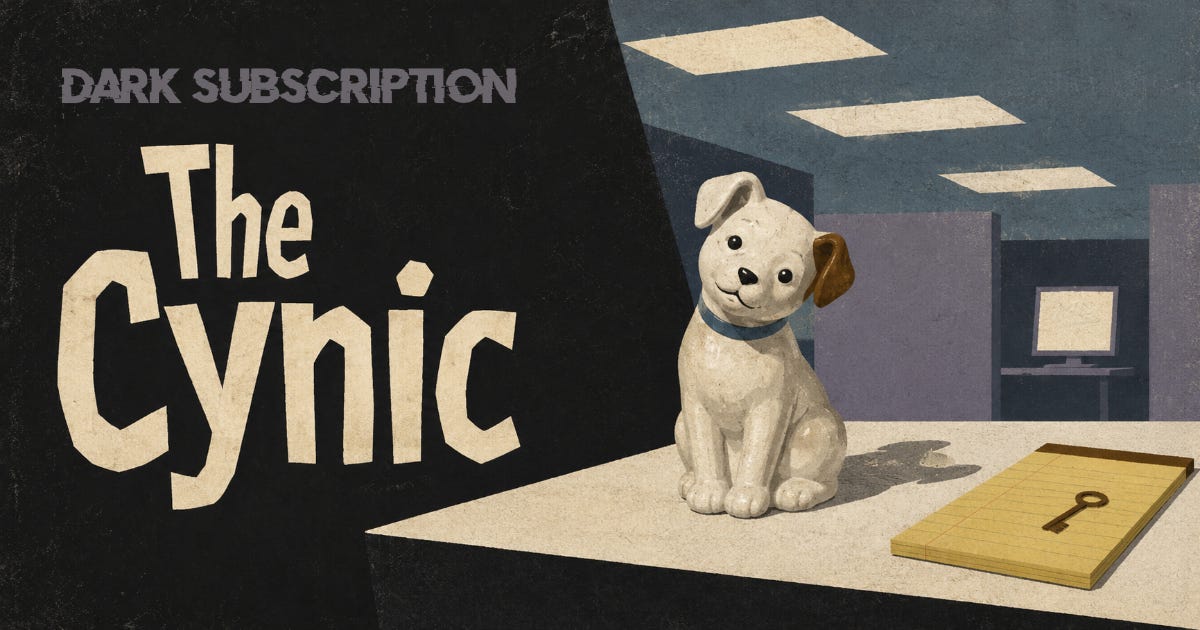
Russ Tolland hated cheerful people on a cellular level.
He hated them in elevators, in break rooms, in parking lots at 7:12 in the morning with damp travel mugs and bright little weather voices like maybe today would finally love them back.
He hated optimism in all its forms, but especially the corporate strain. The emailed kind. The laminated kind. The kind with bullet points and stock photos of coworkers laughing at a salad nobody had touched.
Hope, to Russ, was management pissing on you and telling you it was just rain.
His ex-wife Valerie had subscribed to that same lie, back in the kitchen the year she left him.
“I used to think there was a decent man in there somewhere,” she’d said.
Russ had laughed so hard he snorted.
Three years later, he still thought that had been one of the better laughs of his adult life.
He worked in Compliance Review at Dalton Pike Regional Insurance, which sounded boring because it was. His job was to review bright new ideas from bright new idiots and explain how those ideas would get the company sued, fined, audited, or laughed at by regulators with bad skin and state pensions.
Russ liked saying no for money. It defined him.
People called him names behind his back. They thought he didn’t know. He knew.
Buzzard. Undertaker. Asshole.
The Cynic was the one that stuck.
That one at least had some style.
On a Thursday in October, rain pecked at the windows from dawn on. Russ came in with wet cuffs and a headache behind one eye. At 8:13, Compliance Review got an email with the subject line:
A SMALL CHANGE TO BRIGHTEN YOUR DAY
Russ opened it and felt something tighten behind his nose.
The message came from Internal Culture Initiatives, which was not a department so much as a cult with branded mugs. It announced a new wellness pilot for Compliance Review, part of a department-focused morale initiative designed to support healthier communication, reduce fatigue, and improve team function.
As part of the pilot, each member of the department would receive a desktop trinket selected to reflect their role in the group dynamic.
Russ muttered, “Jesus, send the asteroid.”
By ten o’clock, the trinkets had been hand-delivered to Compliance.
Dana, who handled audit prep and spent half her life chasing signatures, received a ceramic cloud with pink cheeks.
Jeremy, who always seemed to get lost on the way to the copier, was given a brass compass.
Mina, who reviewed claim escalations and always looked one bad phone call away from biting through her headset cord, got a smooth white stone flecked with gold.
At 10:22, a white box appeared on Russ’s desk.
No note. No card.
Inside he found a little ceramic dog.
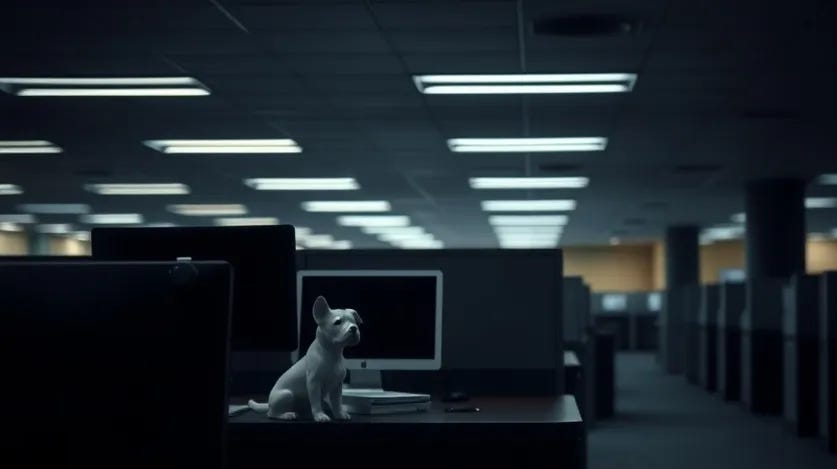
It was maybe four inches high. White glaze, one brown ear, a blue collar painted around its neck. It sat on its haunches like a well-trained pet waiting for a command. One ear stood up. The other flopped. Its head tipped slightly, like it had heard something far away and was still deciding what it meant.
Dana popped her head over the divider. “What’d you get?”
He held it up between two fingers.
She smiled. “Stop. That’s actually adorable.”
“It looks like something you’d buy in a hospital gift ship.”
Dana’s smile thinned. “Maybe it’s trying to tell you something.”
“It is,” Russ said. “It’s telling me that comittee is needs to be put down behind the building.”
He set the dog beside his monitor.
It sat there, cast in the blue-grey light of a spreadsheet, looking back with a blank, glazed stare. He tried to focus on an audit for a claimant in Kettering, but the plastic weight of the thing felt like an itch he couldn’t scratch.
By lunch, the first wrong thing happened.
Brent from Legal stopped by with a draft memo, one of those soft drive-bys where people pretended they wanted expertise and actually wanted forgiveness.
Russ skimmed the first paragraph. “This reads like somebody dictated it through clenched teeth while an HR rep rubbed their shoulders.”
Brent gave a tight smile. He wore it like a tie.
Then Russ heard himself say, “And if I have to fix one more of your citations, I’m going to start wondering whether your law degree came with fries.”
The smile slipped.
Brent’s eyes dropped to the dog.
“Where did you get that?”
Russ followed his gaze. “Culture Initiatives.”
Brent didn’t smile this time.
He set the memo down more carefully than he needed to.
“My father had one.”
Russ almost laughed. “Same creepy little mutt?”
Brent nodded. Sweat had started above his lip.
“He got it from work when I was a kid. Different company. Kept it on his desk for years. Then he started covering it with a handkerchief.”
“Why?”
Brent held his gaze for a second, then looked away. “He wouldn’t talk about it.”
He took the memo and walked off.
The afternoon turned mean.
At the printer, Dana told a woman from Underwriting, “I only invited you because if I didn’t, you’d sulk and make it weird.”
At 2:06, Mina leaned over Russ’s partition with a stack of forms.
“Can you look at this denial language when you get a sec?”
He had something ready. He always had something ready for Mina.
But “of course,” was all he said. “Leave them here, I’ll get to it before end of day.”
Mina blinked.
“Okay,” she said slowly. “Um…thanks, Russ.”
She walked away. He watched her go and tried to remember what he’d actually meant to say.
Across the aisle, Dana was staring at him.
Russ sat down and looked at the dog.
Same ear. Same head tilt. Same dumb sweet glaze.
At 3:11 Beth Kessler called him into her office.
Beth’s office was immaculate. Everything squared. Everything considered.
She gestured to the chair across from her desk without looking up from her laptop. “Sit down, Russ.”
He sat.
A ceramic key was next to her monitor. White glaze, pale blue in the bow. He didn’t know why he noticed it. It was just there, the way a stapler was there, the way the yellow pad squared to the desk edge was there.
On the base, in small neat letters, one word.
ENABLE
Beth closed the laptop.
“How are you finding the week?” she said.
Russ opened his mouth.
“Good,” he said. “Productive.”
Beth nodded. Made a note on the yellow pad without looking down. The way people write when they already know what they’re going to write.
“And the team. How does communication feel lately?”
It wasn’t really a question.
Russ heard himself say, “Better, I think. I’ve been trying to be more considerate before I respond to people.”
Something in Beth’s face didn’t move.
“That’s good to hear,” she said. “I’ve always thought there was more range in you than you typically showed.”
Russ said, “I think you might be right.”
He listened to himself say it.
Beth touched the base of the key once.
She wrote something else on the yellow pad.
“I’m glad we had this.” She opened the laptop again. “I think this quarter is going to be different.”
Russ thanked her.
He was in the elevator before he understood that he had thanked her.
By 4:02 the office had the used-up look of a place that had said too much. Chairs squeaked. Drawers slammed. Somebody gave a short laugh that died halfway out.
The dog sat beside Russ’s monitor in the same patient pose. Same ear. Same head tilt.
He closed his laptop, slid it into his bag, and left.
His condo smelled like old ice, dust, and something sweet going bad under the refrigerator. He poured bourbon into a coffee mug and drank half of it standing at the counter.
He considered food. Rejected it. Opened the freezer anyway. Closed it again.
He took the mug to the bedroom, sat on the edge of the mattress, and drank until the bourbon was gone. At some point he lay down still dressed except for his shoes.
He woke in the office after hours.
At least he thought it was the office.
The cubicle walls were taller. The air was colder. Monitors glowed blue in the dark like tank glass in an aquarium. Somewhere overhead the fluorescents hummed with that old electrical throat-clear that always made him think of hospitals and high school.
The ceramic dog sat beside his keyboard.
Same ear. Same head tilt.
Its glaze caught the blue light and held it.
Then the floor changed.
Slowly. The way a smell changes a room before you name it.
Dana was at her desk, laughing at something a woman from Underwriting had said. Actually laughing, shoulders moving, coffee held loose in one hand. The woman from Underwriting laughed back. They looked at each other the way people do when they mean it.
Jeremy found the copier on the first try. Stood there looking pleased about it. Fed his pages in without checking twice.
Mina on the phone, headset cord hanging loose, voice low and patient. “Of course. Take your time. I’ll be right here.”
Russ stood in the center of it.
The office hummed. People moved around him, unhurried. Someone refilled the coffee. Someone held a door. Voices said of course and no problem at all and let me know if there’s anything else I can do, and every word landed clean. No seam in any of it. No gap between the sound and the meaning.
He understood that this was supposed to be good.
That was the part that turned his stomach.
He tried to say something. Something specific and barbed. The kind of observation he’d been making his whole career, the ones that cut because they were true, the ones that kept the room honest. He opened his mouth.
Good morning, he heard himself say.
He tried again.
Let me know if you need anything.
His own voice. Warm. Unprompted. Genuine as a firm handshake.
Across the floor, Beth stood in her office doorway.
Oatmeal cardigan. Yellow legal pad squared against her forearm. She watched the room the way a facilities manager watches a building when the HVAC is finally running right.
She held the key loosely in her hand.
She didn’t look at Russ for a long time.
The office kept moving. Warm. Frictionless. Everyone finding their way to the copier, to the phone, to each other, without effort.
Then Beth looked at him.
She made a small note on the yellow pad.
He woke with his heart pounding so hard it hurt.
The room was dark. His throat burned. His T-shirt clung to him. The ceiling fan came into focus. The dresser. The half-open closet door. The red digits of the clock.
The apartment was silent.
He sat up too fast and had to clamp a hand over his mouth.
A minute later he was in the bathroom, spitting sour bourbon taste into the sink and waiting to see if he was going to throw up.
He rinsed his mouth and looked up.
Same face. Same burst veins around the nostrils. Same soft shelf under the chin. Same mouth, a little crooked, like it had been arguing with itself for years.
He breathed in through his nose.
The dream sat behind his eyes. Beth’s face. The yellow pad. The way the whole floor had looked bathed in that awful cooperative light.
He now knew what it meant.
The next morning he got in early.
The office lights hummed on in rows. Empty desks. Coffee machines warming up in the break room. The gray first light made everything look washed and temporary.
Russ walked past Dana’s cloud and Mina’s stone.
They sat where they had always sat.
He stepped into Beth’s office without knocking.
Her desk was neat in a way that made the rest of the office feel sticky by comparison. Laptop centered. Yellow pad squared to the edge. Pen aligned across the top as if somebody had measured it.
Near the monitor sat the small ceramic key.
White glaze. Pale blue worked into the bow. Rounded edges. Soft little thing.
On the base, in tidy black letters, one word.
ENABLE
He stood there looking at it.
The department rollout email. The desk-by-desk delivery. Dana’s cloud, which made her frictionless, easy to overlook, easy to manage. Mina’s stone, which made her compliant without breaking. Jeremy’s compass, which kept him just lost enough. The dog, which stripped the one layer Russ had ever bothered with.
Yesterday made sense now. Not a bad day. A baseline.
Beth wasn’t making them better. She was making them manageable.
He stood there in her office with that understanding sitting in his chest like a swallowed key of his own, and he did not pick it up, and he did not take it, and he knew with complete certainty that Brent’s father had stood somewhere just like this, in some other office, in some other building that smelled like printer toner and managed expectations, and had gone back to his desk and pulled a handkerchief out of a drawer.
Russ went back to his cubicle.
At 8:07 Dana stopped by with her coffee held in both hands.
“You okay?” she asked. “Yesterday was kind of a lot.”
He looked up at her. The careful smile. The tired eyes. The way she held the cup like it might steady her.
“I’m fine,” he said. “Really. I think I just needed to hear myself yesterday to understand some things.”
Dana’s face opened up. Warm. Relieved.
“That’s actually kind of healthy,” she said.
Russ smiled back at her.
He felt it happen. The smile arriving on his face without friction, without the usual three-beat delay where he decided whether it was worth the effort. Just a smile, clean and ready, like it had been waiting behind his teeth all along.
Dana moved on.
Russ sat.
Around him the office woke up. Chairs rolling. Printers clicking. Phones beginning to ring.
He looked at the dog.
Same ear. Same head tilt. Same patient, empty glaze.
Somewhere in his chest, in a room that was getting smaller, the Cynic stood at the window with his arms crossed.
He thought about Brent’s father. The handkerchief. All those years of keeping the thing covered, the effort of it, and still never talking about what he’d seen.
He opened his desk drawer. Saw his own handkerchief right where he left it.
The dog sat in the morning light, watching him with that soft, blank attention.
His hand rested on the edge of the drawer.
He thought: good morning.
He thought: let me know if there’s anything I can do.
He thought: that’s actually kind of healthy.
His own voice. Already. Before nine o’clock.
The drawer was open.
He left his hand where it was.